

The manufacturing landscape in the Asia-Pacific region (APAC) is undergoing a thrilling transformation. Gone are the days of solely relying on manual labor. Today, cutting-edge technologies are being woven into the fabric of production, propelling APAC into a global leader in smart manufacturing.
This revolution is driven by a powerful force: digital transformation. Companies are embracing tools like the Internet of Things (IoT), data analytics, and cloud computing to streamline operations and gain a competitive edge. Imagine production lines humming with connected devices, sensors streaming real-time data, and intelligent algorithms optimizing processes – that’s the magic of digital transformation at work.
One standout star in this tech constellation is the Industrial Internet of Things (IIoT). Imagine a manufacturing plant where machines aren’t just churning out products, but also talking to each other, sharing data, and making decisions based on real-time insights. That’s the power of IIoT. It fuels real-time monitoring, predictive maintenance, and data-driven decision-making, taking operational efficiency to a whole new level.
But it’s not just about data and sensors. Automation and robotics are changing the game on the factory floor. From nimble robots assembling intricate components to tireless machines handling materials and ensuring quality control, the human-robot partnership is rewriting the rules of production. This synergy boosts precision, efficiency, and output, while reducing costs and errors.
And who’s pulling the strings behind this intelligent dance? Artificial intelligence (AI) and machine learning (ML) are the masterminds. These technologies analyze vast amounts of data, predict demand, optimize processes, and ensure peak performance. Think of them as the invisible efficiency gurus whispering insights into the ear of the manufacturing process.
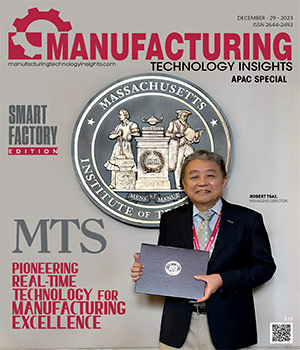
Take MTS for example, it is a company that provides smart manufacturing solutions. It helps companies in a variety of industries, including the semiconductor, paper, power, and steel industries. Its solutions use a variety of technologies, including AI, digital twins, edge computing, and business intelligence.
In this edition, we aim to provide our readers with insights into the current smart factory space and innovations in this sector.